Contact printing for motion picture film
Contact Printing for Motion Picture Film
Contact printing for motion picture film is a photochemical reproduction process in which an unprocessed raw film stock is exposed while held in direct physical contact with a developed original film—typically a camera negative. Light passes through the negative and exposes the raw stock, producing a positive print. This method has historically been used for distribution prints, work prints, and archival duplication.
Historical overview
Early Contact Printing and the Cinématographe
The first motion picture device capable of contact printing was the Cinématographe, patented on February 13, 1895 by Auguste Lumière and Louis Lumière.
The Cinématographe was a three-in-one machine, functioning as a camera, projector, and printer. When used for printing, a developed negative was placed in direct contact with unexposed positive film. Both strips were advanced together and exposed to light through the optical system.
Key characteristics of early contact printing using the Cinématographe:
Intermittent movement: A claw mechanism—derived from sewing machine technology—advanced the film frame by frame, ensuring precise registration.
Standardization: The use of 35mm film contributed to the format’s eventual adoption as the industry standard.
Portability: Weighing approximately 16 lbs (7.3 kg) and operated by a hand crank, it was far more portable than contemporaneous electrically powered studio systems.
Frame-based exposure: Each frame was exposed while stationary, minimizing image blur.
Because the same intermittent mechanism was used for filming, projecting, and printing, the Cinématographe is considered an early example of a step contact printer.
Reference:
https://www.institut-lumiere.org/le-cinematographe-lumiere
Industrialization of Contact Printing
Bell & Howell Continuous Contact Printers
By the early 1910s, the growing film industry required faster and more reliable methods for producing large quantities of prints. One of the first commercially successful solutions was the Bell & Howell Model D, introduced around 1911–1912.
The Bell & Howell Model D was a continuous contact printer, designed for high-speed, industrial-scale print production. Unlike step printers, it transported film in constant motion past the exposure aperture.
Key features and technical characteristics:
Continuous printing method: Negative and positive film were run emulsion-to-emulsion over a sprocket or roller system.
Sprocket-driven registration: The leading edges of the perforations were engaged by sprocket teeth to maintain alignment during exposure.
Semi-automatic light control: Exposure adjustments were electrically actuated but pre-set by an operator.
Precision engineering: Built from robust materials for durability and consistency in long production runs.
Continuous contact printer
In a continuous contact printer, the negative and positive films are brought together on a sprocket (or roller) and move in constant, uniform motion across an illuminated aperture where the exposure occurs.
The leading edges of the perforations in both films are engaged by the teeth of the main sprocket, which carries them past the printing aperture as it rotates.
Proper contact between the two films is achieved by bending them longitudinally at the printing aperture and by the tension created from the weight of the rollers above. The sprocket is enclosed so that light reaches the films only at the printing aperture.
Exposure is controlled by adjusting the aperture or the intensity of the illumination by using the neutral density filter (ND filters).
Most popular models in artist-run film labs:
1. Bell & Howell Model C Continuous PrinterBH modelC manual

2. Bell & Howell Model D/J Continuous PrinterBH Model D Manual

Other professional printer:
BHP Panel Printer


source: https://mmtfilm.com/bhp-film-printers
Portable version:
Compact cine film printer
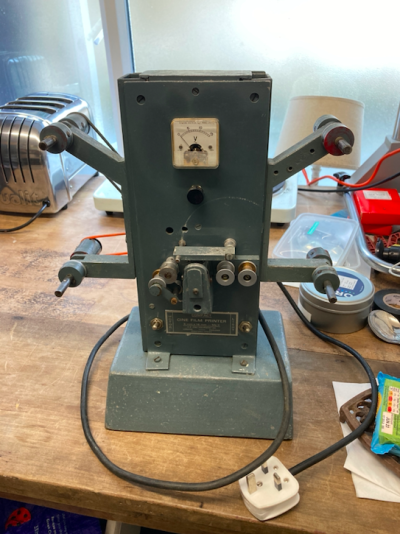

Uhler Cine 16mm Printer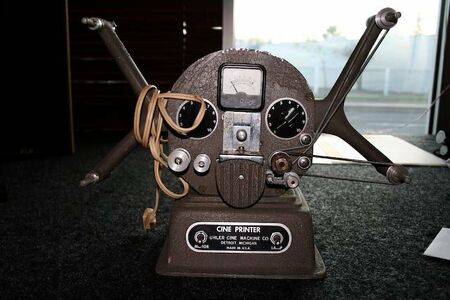
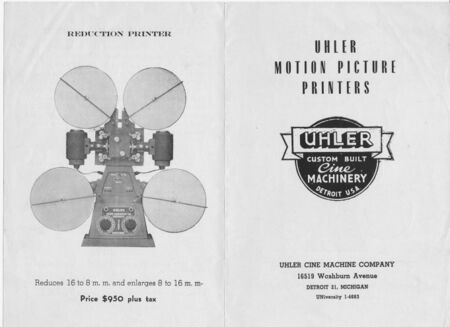
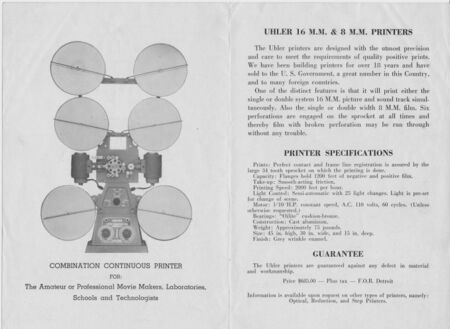


Naval 16mm printer
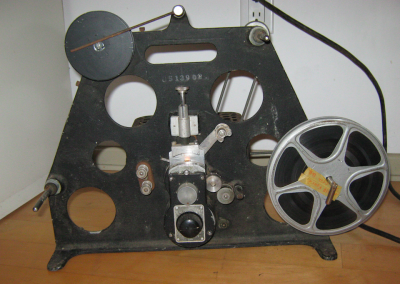

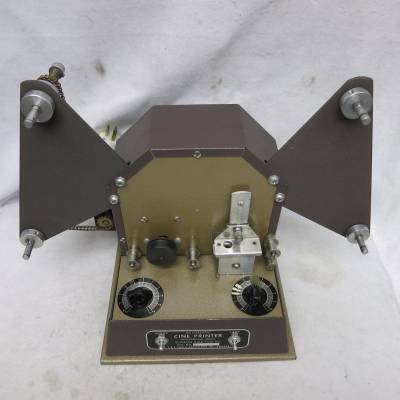
Superior Cine printers

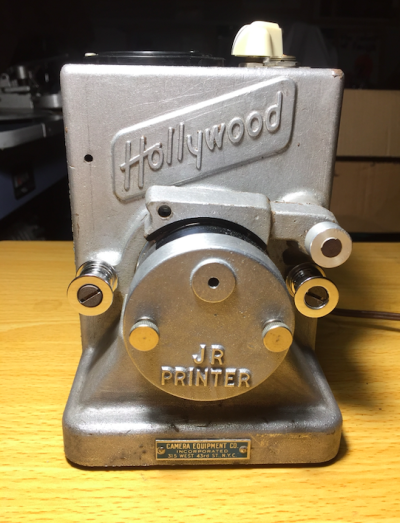
Hollywood Junior printer

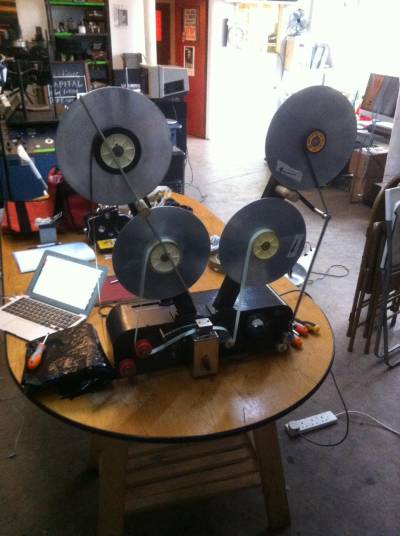
Dutch printer Kinoptiek

Step contact printer
In step printers, the negative and positive films are moved intermittently, as in the camera, and each frame is exposed as a unit while stationary in front of the printing light. A shutter placed in front of the printing aperture cuts off the light while the negative and positive film are being moved into position for the next exposure. The amount of exposure is usually controlled by altering the intensity of the light.
In a step printer, the exposure is made when both films are at rest; consequently, there can be no loss of definition in the print from movement of the films with respect to one another during the exposure. The use of step printers for badly shrunken negatives may be justified in the interests of better definition. For example, some film preservationists often create duplicates of old original film negatives through a frame-by-frame step process using an optical printer.
For printing from the sound negative, however, the only permissible type of printer is the continuous machine. The frame line created by the step printer process will create additional audio pulses.
Artist-run and DIY approaches
1. Contact printing with a flat-bed editing table.
It is the popular method used in a lot of artist-run film labs. Especially at filmwerkplaats.
Here is a picture of a Steenbeck editing table modified into a printer by Esther Urlus.
source: https://estherurlus.hotglue.me/flatbedprinting
2. projector as contact printer
A double-loaded projector with two rewinders to collect the second reel of film
source: https://www.filmkorn.org/making-diy-prints-from-color-negative-film/?lang=en
3. Bolex camera as a contact printer
"The camera itself can be loaded with neg. and print in the dark room, and then run without a lens, allowing light to expose the stock. Longer sections can be done this way but the camera has a tendency to jam with the double thickness of film, so a hand crank assist is useful. Again, do exposure tests before attempting a mega length."
from
To Boldly Go: a starters guide to hand made and d-i-y films by Esther Urlus
source: https://mononoawarefilm.com/2021-feb-diy-contact-printing-bipack-bolex
4. Contact printing with a torch/flashlight
- The simplest way to copy something without any special machines is by flatprinting: laying raw film stock flat on a straight surface, placing your original film or object on the film, flattening the ensemble to ensure contact using a piece of glass, and using a flashlight or other manageable light source to expose the film. This practice has a length limitations (usually about 2 meters).
To Boldly Go: a starters guide to hand made and d-i-y films by Esther Urlus
https://estherurlus.hotglue.me/?d-i-y.head.137581437028&download=1
Reference:
https://www.nfsa.gov.au/preservation/preservation-glossary/contact-printer
https://www.l-abominable.org/en/tools/contact-printer/
https://mononoawarefilm.com/workshop-contact-printing-june
SMPE Standards
Society of Motion Picture Engineers (SMPE, now SMPTE).
Eastman Kodak invented and introduced the 16mm film format in 1923, including its original double-perforation standard. Bell & Howell manufactured highly popular and reliable 16mm cameras and projectors (such as the Filmo series) that used this standard, and their equipment was known for its precision, which helped enforce the de facto standard in practice.
Their manufacturing precision meant that their equipment became a benchmark. Film perforated to the "Bell & Howell gauge" was a mark of quality and compatibility in printing and projection.
The 16mm standard, once introduced by Kodak, was quickly adopted by the industry and standardized by professional bodies like the Society of Motion Picture Engineers (SMPE, now SMPTE).
Scans of SMP(T)E Indexes and Issues Available Online:
https://www.aes.org/aeshc/docs/smpte/smp%28t%29e-journal.html
16mm SMPE Standards=


Figures from the SMPE Journal Volume 19, November 1932
Reference: https://www.brianpritchard.com/16mm_windings.htm
“SECRETS OF SUPERIORITY” 1940s BELL & HOWELL 16mm FILMOSOUND PROJECTOR SALES FILM 13074
https://www.youtube.com/watch?v=9wB0SyrZzDU&list=LL&index=8&t=100s
Prestwich 35mm Motion Picture Camera from 1899
https://www.youtube.com/watch?v=kTEJ0a1zS4Q&list=LL&index=11
Operation of the Bell and Howell sound projector (1957)
https://www.youtube.com/watch?v=fAYOK55wzh4&list=LL&index=9&t=213s