Contact printing for motion picture film
Contact Printing for Motion Picture Film
Contact printer
A motion-picture contact printer is a machine that exposes unprocessed raw film stock while it is held in direct contact with the original camera negative film. This process is used to create a positive print from the original camera negative for distribution, screening, or archival purposes.
Machines for the printing of motion picture film by contact may be divided into two types, step printers and continuous printers.
Continuous contact printer
In a continuous contact printer, the negative and positive films are brought together on a sprocket (or roller) and move in constant, uniform motion across an illuminated aperture where the exposure occurs.
The leading edges of the perforations in both films are engaged by the teeth of the main sprocket, which carries them past the printing aperture as it rotates.
Proper contact between the two films is achieved by bending them longitudinally at the printing aperture and by the tension created from the weight of the rollers above. The sprocket is enclosed so that light reaches the films only at the printing aperture.
Exposure is controlled by adjusting the aperture or the intensity of the illumination by using the neutral density filter (ND filters).
Most popular models in artist-run film labs:
1. Bell & Howell Model C Continuous PrinterBH modelC manual

2. Bell & Howell Model D/J Continuous PrinterBH Model D Manual

Other professional printer:
BHP Panel Printer


source: https://mmtfilm.com/bhp-film-printers
Portable version:
Compact cine film printer
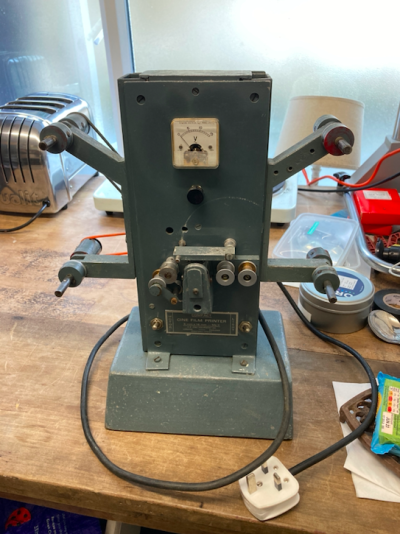

Uhler Cine 16mm Printer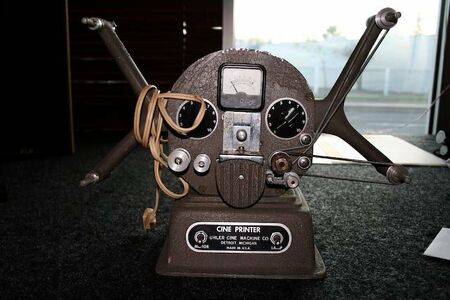
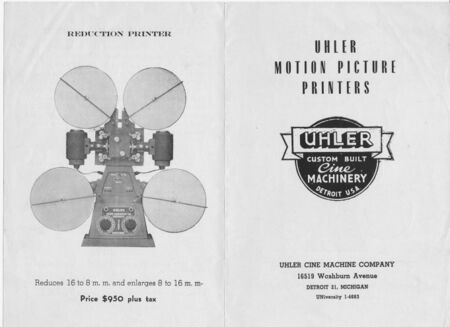
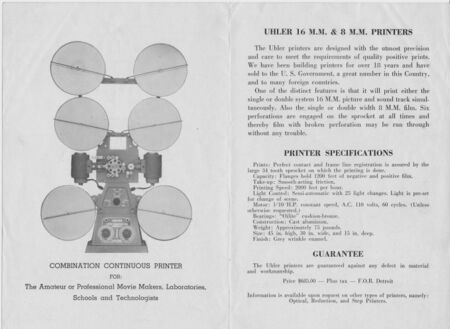


Naval 16mm printer
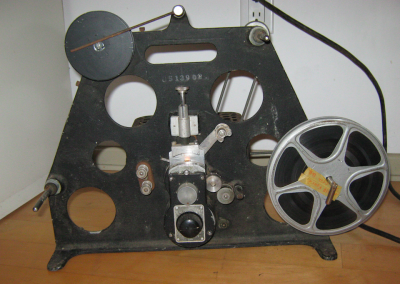

Superior Cine printers
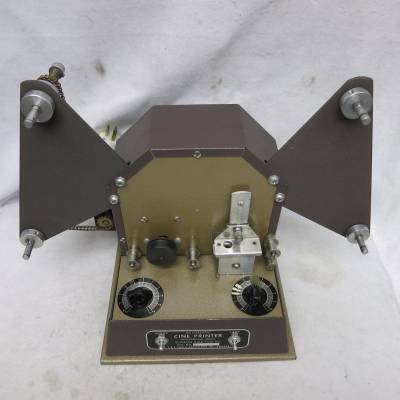

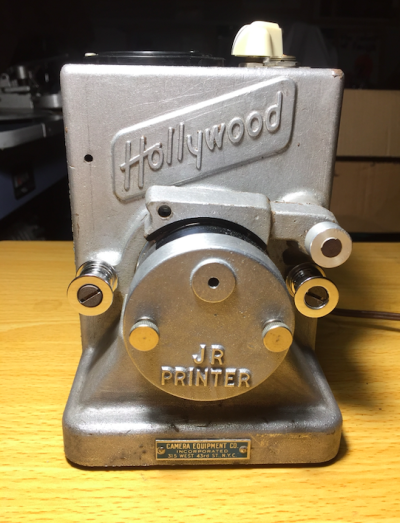
Hollywood Junior printer

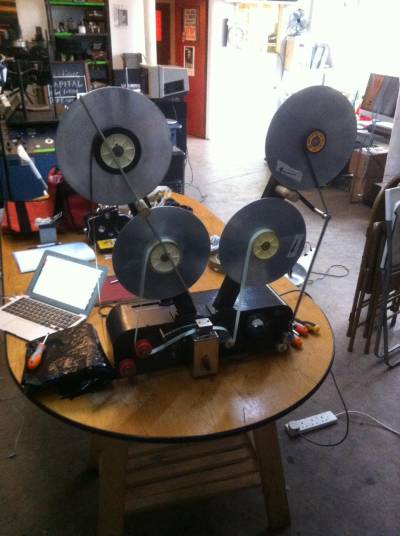
Dutch printer Kinoptiek

Step contact printer
In step printers, the negative and positive films are moved intermittently, as in the camera, and each frame is exposed as a unit while stationary in front of the printing light. A shutter placed in front of the printing aperture cuts off the light while the negative and positive film are being moved into position for the next exposure. The amount of exposure is usually controlled by altering the intensity of the light.
In a step printer, the exposure is made when both films are at rest; consequently, there can be no loss of definition in the print from movement of the films with respect to one another during the exposure.
In a continuous printer, however, both films are in motion during the exposure; if the perforation pitch is not the same for both films, as is usually the case, it is necessary to compensate for the difference in the perforation pitch of the two films. This is taken care of by the curved gate of the printer.
The use of step printers for badly shrunken negatives may be justified in the interests of better definition.
For printing from the sound negative, however, the only permissible type of printer is the continuous machine.
Reference:
https://www.nfsa.gov.au/preservation/preservation-glossary/contact-printer
https://www.l-abominable.org/en/tools/contact-printer/
https://mononoawarefilm.com/workshop-contact-printing-june
SMPE Standards
Society of Motion Picture Engineers (SMPE, now SMPTE).
Eastman Kodak invented and introduced the 16mm film format in 1923, including its original double-perforation standard. Bell & Howell manufactured highly popular and reliable 16mm cameras and projectors (such as the Filmo series) that used this standard, and their equipment was known for its precision, which helped enforce the de facto standard in practice.
Their manufacturing precision meant that their equipment became a benchmark. Film perforated to the "Bell & Howell gauge" was a mark of quality and compatibility in printing and projection.
The 16mm standard, once introduced by Kodak, was quickly adopted by the industry and standardized by professional bodies like the Society of Motion Picture Engineers (SMPE, now SMPTE).
Scans of SMP(T)E Indexes and Issues Available Online:
https://www.aes.org/aeshc/docs/smpte/smp%28t%29e-journal.html
16mm SMPE Standards=


Figures from the SMPE Journal Volume 19, November 1932
Reference: https://www.brianpritchard.com/16mm_windings.htm
SMPE Standards 1928
Reference: