Variable density sound: historical research: Difference between revisions
| Line 129: | Line 129: | ||
Image source: | |||
https://www.archives.gov/preservation/formats/motion-picture-film-identify-formats.html | https://www.archives.gov/preservation/formats/motion-picture-film-identify-formats.html | ||
https://en.wikipedia.org/wiki/Optical_sound | |||
==Definition and Technical Description== | ==Definition and Technical Description== | ||
Revision as of 22:54, 26 December 2025
Definition
Variable density (VD) sound is an optical sound-on-film recording system in which audio signals are represented by variations in the optical density (darkness) of a photographic soundtrack. Sound amplitude is encoded as changes in exposure rather than changes in track width.
Variable density sound was one of the earliest standardized methods for synchronized sound cinema and was widely used in studio and laboratory contexts during the late 1920s and early 1930s. While eventually displaced in theatrical release printing by variable area systems, VD sound played a foundational role in the industrialization of sound-on-film recording and mastering.
Variable Density soundtrack 16mm .................Variable Area soundtrack 16mm


Principle of Operation
In a variable density system, an electrical audio signal modulates the intensity of a light source during exposure onto photographic film. Louder sounds increase or decrease the amount of light reaching the film, producing corresponding variations in density after development.
During playback, steady illumination passes through the developed soundtrack. The transmitted light varies according to the recorded density pattern and is converted back into an electrical signal by a photoelectric cell. This signal is then amplified and reproduced as sound.
Unlike variable area sound, where audio is encoded geometrically as changes in track width, variable density relies on the photographic response curve of the film stock, making exposure control, development consistency, and laboratory calibration central to sound quality.
Historical Development
Early Experimental Optical Sound (1904–1926)
Early attempts to record sound directly onto motion picture film predate the industrial standardization of optical sound by several decades. These experiments treated sound recording as a photographic and mechanical problem, often involving modified cameras, projectors, and printing equipment rather than purpose-built sound systems.
One of the earliest known efforts was Lauste Sound and Scene (1904–1913), which explored multiple methods for inscribing sound onto film using optical and mechanical techniques. Although technically innovative, these experiments did not reach commercial viability, in part due to limitations in recording stability, amplification, and reproduction.
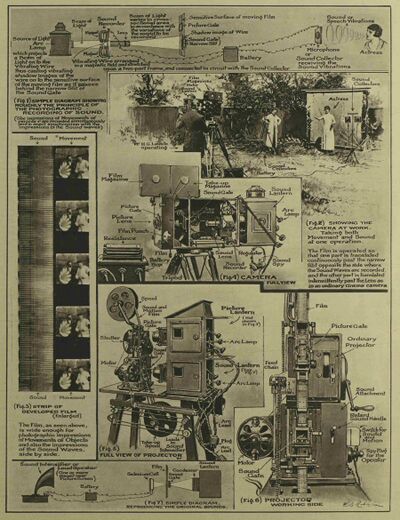 Series of diagrams illustrating Lauste’s Sound and Scene camera and projectors. Robinson, W. B. (1920). “Speaking Movies: Synchronising Sound and Picture”. Illustrated London News (January 10, 1920): p. 45.
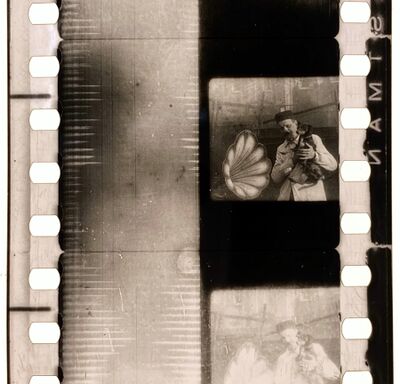 Duplicate of a Lauste Sound and Scene experiment, with the variable-density soundtrack (left) and the image (right) recorded simultaneously. Original experiments dated 1911–1912. 35mm nitrate print, c. 1935. George Eastman Museum, Rochester, NY, United States.
A more systematic laboratory-based approach emerged with the Case Research Laboratory Optical Sound (c.1922–1926). The Case laboratory developed experimental variable-density optical soundtracks using modified motion picture cameras, projection mechanisms, and a Bell & Howell Model D printer repurposed for sound exposure. Rather than encoding sound as a narrow standardized track, Case’s system produced variable-density sound recordings as complete photographic images.


Documented experiments include variable-density recordings of the spoken alphabet (A–Z), preserved in laboratory notebooks dated May 9, 1924. These recordings functioned as calibration tests and analytical tools, allowing researchers to study sound-to-image correspondence through direct visual inspection of density patterns. This approach emphasized laboratory control, apparatus modification, and photographic analysis over compatibility with existing projection standards.
Although neither Lauste nor Case systems were commercialized, their work established critical conceptual foundations for later optical sound technologies by demonstrating that sound could be recorded, analyzed, and reproduced as a photographic inscription on film.
Reference:
Case Research Laboratory Optical Sound(1922–1926): https://www.filmatlas.com/entry/355
Lauste Sound and Scene(1904–1913): https://www.filmatlas.com/entry/325
Interesting read: Writing sound with a human ear: reconstructing Bell and Blake’s 1874 ear phonautograph
https://journal.sciencemuseum.ac.uk/article/writing-sound/#introduction
Transition Toward Standardized Variable Density Systems (Late 1920s)
The experimental practices developed by laboratories such as Case informed the emergence of more standardized variable density sound systems in the late 1920s. These later systems retained the photographic encoding principles explored in earlier experiments while introducing narrower track geometries, improved amplification, and greater compatibility with industrial printing and projection workflows.
Variable density sound emerged during the transition from silent to synchronized sound cinema. Early optical sound systems favored density-based encoding because it aligned closely with existing photographic and laboratory practices. Continuous tonal variation could be recorded using familiar exposure control techniques, making VD sound attractive to studios and film laboratories adapting to synchronized sound.
Major early adopters included systems developed by Fox Movietone and RCA Photophone. These systems demonstrated that optical soundtracks could be photographically stable, mechanically reproducible, and synchronized with image projection.
Industrial Adoption
By the late 1920s, variable density sound had become a dominant studio recording format. Sound was typically recorded in controlled laboratory environments, where exposure, development, and duplication parameters could be carefully managed. VD sound integrated smoothly into studio workflows that already relied on film sensitometry, printing lights, and chemical process control.
Studio Recording and Laboratory Practice
Variable density sound was particularly well suited to studio and laboratory use rather than direct exhibition. Recording systems relied on precision light modulation devices and stable photographic processing. Sound engineers could adjust exposure levels, contrast, and density response during recording and development, treating the soundtrack as a photographic object as much as an audio signal.
This laboratory orientation encouraged the development of intermediate formats that prioritized signal control and noise reduction over projector compatibility.
Studio Formats
Studio variable-density formats refer to intermediate optical sound configurations used during recording, mixing, and mastering. These formats were not intended for projection and often required specialized playback and combining equipment unavailable in standard cinema projectors.
Push-Pull Variable Density
In push-pull VD systems, two complementary density tracks are recorded with inverse modulation. When combined during playback, common noise components—such as film grain or exposure irregularities—are partially canceled, improving signal-to-noise ratio. Push-pull recording was used primarily in studio mastering stages rather than release prints.
Split-Track and Multi-Track Formats
Some laboratory workflows employed split or multiple variable-density tracks to allow balancing, testing, or selective recombination before final mixdown. These formats functioned as technical intermediates rather than exhibition standards.
Printing, Duplication, and Noise Characteristics
Variable density soundtracks were sensitive to photographic variability. Grain structure, exposure inconsistency, development drift, and duplication generational loss directly affected noise and distortion levels. Each printing generation tended to increase background hiss and reduce dynamic range.
These characteristics made VD sound increasingly problematic as film distribution scaled up. High-volume duplication for theatrical release placed demands on consistency and robustness that density-based encoding struggled to meet.
Transition to Variable Area Sound
By the early 1930s, variable area (VA) sound systems began to replace variable density sound for theatrical release printing. Variable area tracks encoded sound as geometric width variations rather than density changes, making them less sensitive to film grain and photographic inconsistencies.
The transition did not represent a failure of variable density as a recording method, but rather an industrial optimization. VD sound remained valuable in studio and laboratory contexts even as VA became the dominant release format.
Archival and Research Relevance
Variable density sound remains highly relevant in archival and research contexts. Many early sound films survive only as VD optical tracks, requiring careful calibration during digitization and restoration. Modern optical sound scanning workflows must account for photographic density response, exposure history, and noise characteristics unique to VD encoding.
Understanding variable density sound is therefore essential for film preservation, historical audio reconstruction, and media-archaeological research into early sound cinema technologies.
old-info:
Overview
Optical soundtracks encode audio signals as optical variations directly on the film strip. Two primary analogue optical formats were used historically:
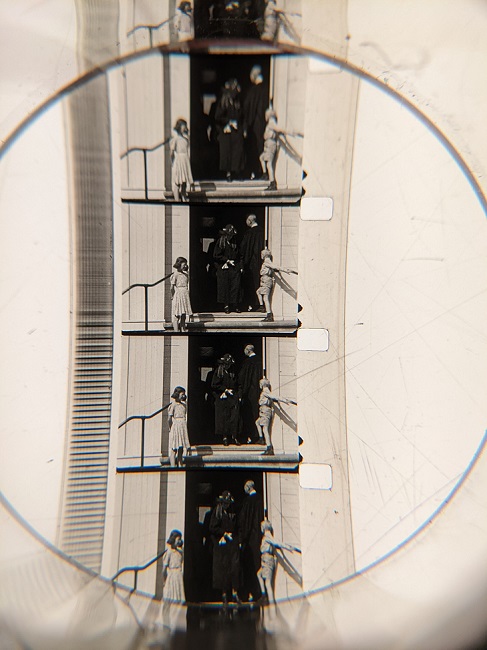 Variable Density (VD): the darkness of the soundtrack varies with the sound waveform.
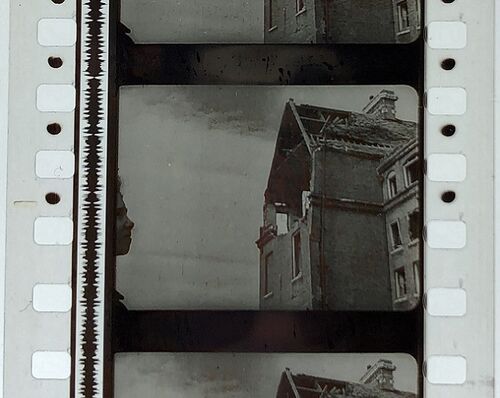 Variable Area (VA): the width of a clear area (against opaque background) varies with the sound waveform.

VD and VA compete in mechanisms of encoding but use the same playback hardware. Variable density predominated in the early sound era and was gradually replaced by variable area due to ease of printing and noise performance.
Image source:
https://www.archives.gov/preservation/formats/motion-picture-film-identify-formats.html
https://en.wikipedia.org/wiki/Optical_sound
Definition and Technical Description
Variable Density
A variable density soundtrack represents audio by varying the opacity (density) of the soundtrack area on the film. As the film passes a light in the projector’s sound head, the varying density modulates light reaching a photoelectric cell, producing an electrical signal that mirrors the original audio waveform.
In VD, every part of the soundtrack has the same width; it’s the degree of transparency that changes.
This produces a continuous optical waveform corresponding to amplitude.
VD tracks can be read by the same optical readers as VA tracks.
Variable Area
Variable area soundtracks record sound by altering the width of a transparent region against an opaque background, with amplitude reflected in the extent of the clear area rather than its density.
VA became the standard from the mid-1940s onward due to lower signal variability during printing and better noise performance in mass production.
Video Clip 4: Classic Optical Sound Recording
https://www.nfsa.gov.au/preservation/preservation-glossary/variable-density
https://www.sprocketschool.org/wiki/Variable_density
https://www.sprocketschool.org/wiki/Variable_area
https://en.wikipedia.org/wiki/Optical_sound
Principles of Operation
Both VD and VA tracks work on the same basic optical principle:
A light source illuminates the soundtrack area.
Sound-modulated variations on the film affect how much light passes through.
A photoelectric cell (phototube or photodiode) converts fluctuations in transmitted light into electrical signals.
These electrical signals are amplified and output as sound.
Optical Soundtrack Formats
Optical sound on film exists in two functional categories: studio formats and release formats.
Studio optical formats—such as push-pull variable density, push-pull variable area, and other multi-track or split-track configurations—were used for sound recording, noise reduction, balancing, and laboratory mastering, and require specialized studio playback equipment. They were never intended for exhibition and cannot be reproduced correctly on standard projectors or editing tables.
Release formats, including variable density and the various forms of variable area soundtracks, are finalized single-track optical recordings designed for mass printing and reliable playback on conventional optical film projectors.
Release formats
Release formats are finalized optical soundtracks intended for mass printing and direct playback on standard film projectors and editing tables.
Variable-density (VD), Unilateral variable-area (VA), Bilateral variable-area, Duplex variable-area...

Studio formats
Studio formats are intermediate optical soundtracks used during recording and laboratory processing.
Push-pull variable-density (VD) variants
Push-pull variable-area (VA) variants
Other multi-track or split-track studio configurations

Endpoint Audio Labs:https://www.endpointaudio.com/optical-sound-detail
Widescreen Museum: https://www.widescreenmuseum.com/sound/RCA06-4.htm
History
Pre-Cinema Optical Sound Development (Early 1900s)
Before commercial optical sound systems, inventors like Eugène Augustin Lauste experimented with optical transcription of audio. Lauste developed sound-on-film prototypes that used both variable area and variable density techniques in the 1900s–1910s.
Lauste Sound and Scene(1904–1913) (Photocinematophone, Laustophone) A series of interrelated experiments using both variable-density and variable-area to create some of the first sound-on-film with synchronized picture recordings.
Film Atlas: https://www.filmatlas.com/entry/325

Series of diagrams illustrating Lauste’s Sound and Scene camera and projectors.
Robinson, W. B. (1920). “Speaking Movies: Synchronising Sound and Picture”. Illustrated London News (January 10, 1920): p. 45.

Duplicate of a Lauste Sound and Scene experiment, with the variable-density soundtrack (left) and the image (right) recorded simultaneously. Original experiments dated 1911–1912. 35mm nitrate print, c. 1935.
George Eastman Museum, Rochester, NY, United States.
Writing sound with a human ear: reconstructing Bell and Blake’s 1874 ear phonautograph
https://journal.sciencemuseum.ac.uk/article/writing-sound/#abstract
Key Systems and Implementations
Phonofilm (1920s)
Phonofilm was an early optical sound-on-film system developed by Lee de Forest and improved with technical contributions from the Case Research Laboratory. It recorded sound as parallel lines of variable shades of gray, a variable density approach.
Phonofilm was produced commercially from the early 1920s and used in short films, musicals, and vaudeville recordings.
https://en.wikipedia.org/wiki/Phonofilm
https://www.leedeforest.org/Phonofilm.html
Case Research Laboratory Optical Sound (1922–1926)
The Case Research Laboratory, led by Theodore Case and Earl Sponable, developed key photoelectric and light modulation technologies (e.g., the thalofide photocell, Aeo-light) that made optical sound on film practical. These innovations were used in Phonofilm and later adapted in Movietone systems. Wikipedia
Movietone (Late 1920s–1930s)
The Movietone sound system used a variable density soundtrack and was one of the major optical sound standards in the U.S. film industry. It synchronized sound with picture on the same strip of film and helped establish 24 frames per second as the standard sound film speed. Wikipedia
Fox Film Corporation acquired Case Lab patents and mass-produced Movietone equipment and films. Wikipedia
Movietone was widely used for newsreels and features throughout the late 1920s into the 1930s.
Case Research Laboratory Optical Sound(1922–1926) (Zoephone) A variable-density, single-system optical sound technology developed by the Case Research Laboratory in Auburn, NY, United States. In its commercial form, when paired with Western Electric microphones, amplifiers and loudspeakers, the system later became known as Movietone sound.
https://www.filmatlas.com/entry/355
Other Early Contributions
Pallophotophone and Photophone
The Photophone (Alexander Graham Bell and Sumner Tainter) and related technologies like Pallophotophone represent early experiments in modulating light with audio for transmission and recording, foreshadowing later optical sound on film.
Transition to Variable Area and Later Developments
By the mid-1940s, variable area systems (notably RCA Photophone) became dominant due to easier duplication and quality control in large-scale printing and better consistency between lab and projection.
Variable area soundtracks also became the basis for later stereo optical tracks (e.g., Dolby Stereo).
VD tracks remain playable on modern projectors but are rarely used in new production.
Optical Sound on Film to the Present Day
Optical sound remained in use for decades—even after the introduction of magnetic and, later, digital sound formats—due to the widespread infrastructure built around projectors and film prints. From the 1970s onward, optical stereo formats and digital sound (e.g., Dolby Digital) supplemented or replaced analogue tracks, but optical analogue remains part of the film print standard for compatibility.