Variable density sound: historical research: Difference between revisions
| (27 intermediate revisions by the same user not shown) | |||
| Line 1: | Line 1: | ||
= | ==Definition== | ||
Variable | Variable density (VD) sound is an optical sound-on-film recording system in which audio signals are represented by variations in the optical density (darkness) of a photographic soundtrack. Sound amplitude is encoded as changes in exposure rather than changes in track width. | ||
Variable density sound was one of the earliest standardized methods for synchronized sound cinema and was widely used in studio and laboratory contexts during the late 1920s and early 1930s. While eventually displaced in theatrical release printing by variable area systems, VD sound played a foundational role in the industrialization of sound-on-film recording and mastering. | |||
[[File:12-variabledensity-loupe-2022.jpg|400px]][[File:USN16mmSoundtrack.webp|300px]] | |||
Variable Density soundtrack 16mm .................Variable Area soundtrack 16mm | |||
==Principle of Operation== | |||
In a variable density system, an electrical audio signal modulates the intensity of a light source during exposure onto photographic film. Louder sounds increase or decrease the amount of light reaching the film, producing corresponding variations in density after development. | |||
During playback, steady illumination passes through the developed soundtrack. The transmitted light varies according to the recorded density pattern and is converted back into an electrical signal by a photoelectric cell. This signal is then amplified and reproduced as sound. | |||
Unlike variable area sound, where audio is encoded geometrically as changes in track width, variable density relies on the photographic response curve of the film stock, making exposure control, development consistency, and laboratory calibration central to sound quality. | |||
==Historical Development== | |||
===Early Experimental Optical Sound (1904–1926)=== | |||
Early attempts to record sound directly onto motion picture film predate the industrial standardization of optical sound by several decades. These experiments treated sound recording as a photographic and mechanical problem, often involving modified cameras, projectors, and printing equipment rather than purpose-built sound systems. | |||
One of the earliest known efforts was Lauste Sound and Scene (1904–1913), which explored multiple methods for inscribing sound onto film using optical and mechanical techniques. Although technically innovative, these experiments did not reach commercial viability, in part due to limitations in recording stability, amplification, and reproduction. | |||
[[File:Lauste-technology02final-cpl.jpg|400px]] | |||
Series of diagrams illustrating Lauste’s Sound and Scene camera and projectors. Robinson, W. B. (1920). “Speaking Movies: Synchronising Sound and Picture”. Illustrated London News (January 10, 1920): p. 45. | |||
[[File:Lauste-technology03final-cpl.jpg|400px]] | |||
Duplicate of a Lauste Sound and Scene experiment, with the variable-density soundtrack (left) and the image (right) recorded simultaneously. Original experiments dated 1911–1912. 35mm nitrate print, c. 1935. George Eastman Museum, Rochester, NY, United States. | |||
A | A more systematic laboratory-based approach emerged with the Case Research Laboratory Optical Sound (c.1922–1926). The Case laboratory developed experimental variable-density optical soundtracks using modified motion picture cameras, projection mechanisms, and a Bell & Howell Model D printer repurposed for sound exposure. Rather than encoding sound as a narrow standardized track, Case’s system produced variable-density sound recordings as complete photographic images. | ||
[[File:Case-research-technology03final-cpl.jpg|400px]] | |||
[[File:Case-research-technology01final-cpl.jpg|450px]][[File:Case-research-technology02final-cpl.jpg|400px]] | |||
This | Documented experiments include variable-density recordings of the spoken alphabet (A–Z), preserved in laboratory notebooks dated May 9, 1924. These recordings functioned as calibration tests and analytical tools, allowing researchers to study sound-to-image correspondence through direct visual inspection of density patterns. This approach emphasized laboratory control, apparatus modification, and photographic analysis over compatibility with existing projection standards. | ||
Although neither Lauste nor Case systems were commercialized, their work established critical conceptual foundations for later optical sound technologies by demonstrating that sound could be recorded, analyzed, and reproduced as a photographic inscription on film. | |||
Reference: | |||
Case Research Laboratory Optical Sound(1922–1926): https://www.filmatlas.com/entry/355 | |||
Lauste Sound and Scene(1904–1913): https://www.filmatlas.com/entry/325 | |||
Interesting read: Writing sound with a human ear: reconstructing Bell and Blake’s 1874 ear phonautograph | |||
https://journal.sciencemuseum.ac.uk/article/writing-sound/#introduction | |||
===Transition Toward Standardized Variable Density Systems (Late 1920s)=== | |||
The experimental practices developed by laboratories such as Case informed the emergence of more standardized variable density sound systems in the late 1920s. These later systems retained the photographic encoding principles explored in earlier experiments while introducing narrower track geometries, improved amplification, and greater compatibility with industrial printing and projection workflows. | |||
Variable density sound emerged during the transition from silent to synchronized sound cinema. Early optical sound systems favored density-based encoding because it aligned closely with existing photographic and laboratory practices. Continuous tonal variation could be recorded using familiar exposure control techniques, making VD sound attractive to studios and film laboratories adapting to synchronized sound. | |||
Major early adopters included systems developed by Fox Movietone and RCA Photophone. These systems demonstrated that optical soundtracks could be photographically stable, mechanically reproducible, and synchronized with image projection. | |||
===Industrial Adoption=== | |||
By the late 1920s, variable density sound had become a dominant studio recording format. Sound was typically recorded in controlled laboratory environments, where exposure, development, and duplication parameters could be carefully managed. VD sound integrated smoothly into studio workflows that already relied on film sensitometry, printing lights, and chemical process control. | |||
Classic Optical Sound Recording | |||
{{#ev:youtube|OjKQNykc_04}} | {{#ev:youtube|OjKQNykc_04}} | ||
==Studio Recording and Laboratory Practice== | |||
Variable density sound was particularly well suited to studio and laboratory use rather than direct exhibition. Recording systems relied on precision light modulation devices and stable photographic processing. Sound engineers could adjust exposure levels, contrast, and density response during recording and development, treating the soundtrack as a photographic object as much as an audio signal. | |||
This laboratory orientation encouraged the development of intermediate formats that prioritized signal control and noise reduction over projector compatibility. | |||
===Studio Formats=== | |||
Studio variable-density formats refer to intermediate optical sound configurations used during recording, mixing, and mastering. These formats were not intended for projection and often required specialized playback and combining equipment unavailable in standard cinema projectors. | |||
Push-Pull Variable Density | |||
In push-pull VD systems, two complementary density tracks are recorded with inverse modulation. When combined during playback, common noise components—such as film grain or exposure irregularities—are partially canceled, improving signal-to-noise ratio. Push-pull recording was used primarily in studio mastering stages rather than release prints. | |||
Split-Track and Multi-Track Formats | |||
Some laboratory workflows employed split or multiple variable-density tracks to allow balancing, testing, or selective recombination before final mixdown. These formats functioned as technical intermediates rather than exhibition standards. | |||
[[File:Optical-02.png|600px]] | |||
Release formats are finalized optical soundtracks intended for mass printing and direct playback on standard film projectors and editing tables. | |||
Variable-density (VD), Unilateral variable-area (VA), Bilateral variable-area, Duplex variable-area... | |||
[[File:Release Formats.png|600px]] | |||
==Printing, Duplication, and Noise Characteristics== | |||
Variable density soundtracks were sensitive to photographic variability. Grain structure, exposure inconsistency, development drift, and duplication generational loss directly affected noise and distortion levels. Each printing generation tended to increase background hiss and reduce dynamic range. | |||
These characteristics made VD sound increasingly problematic as film distribution scaled up. High-volume duplication for theatrical release placed demands on consistency and robustness that density-based encoding struggled to meet. | |||
[[File:Cut-off-of-the-first-soundtrack-a-before-restoration-b-after-restoration-Cut-off-of (1).png|600px]] | |||
Restoration of variable density film soundtracks: | |||
https://www.researchgate.net/figure/Cut-off-of-the-first-soundtrack-a-before-restoration-b-after-restoration-Cut-off-of_fig1_281352892 | |||
==Transition to Variable Area Sound== | |||
By the early 1930s, variable area (VA) sound systems began to replace variable density sound for theatrical release printing. Variable area tracks encoded sound as geometric width variations rather than density changes, making them less sensitive to film grain and photographic inconsistencies. | |||
The transition did not represent a failure of variable density as a recording method, but rather an industrial optimization. VD sound remained valuable in studio and laboratory contexts even as VA became the dominant release format. | |||
==Archival and Research Relevance== | |||
Variable density sound remains highly relevant in archival and research contexts. Many early sound films survive only as VD optical tracks, requiring careful calibration during digitization and restoration. Modern optical sound scanning workflows must account for photographic density response, exposure history, and noise characteristics unique to VD encoding. | |||
Understanding variable density sound is therefore essential for film preservation, historical audio reconstruction, and media-archaeological research into early sound cinema technologies. | |||
==Reference:== | |||
'''Optical Sound – General Overviews''' | |||
Widescreen Museum, Classic Optical Sound Recording | |||
https://www.widescreenmuseum.com/sound/RCA06-4.htm | |||
Wikipedia contributors, Optical sound | |||
https://en.wikipedia.org/wiki/Optical_sound | |||
Endpoint Audio, Optical Sound – Technical Detail | |||
https://www.endpointaudio.com/optical-sound-detail | |||
'''Variable Density and Variable Area Sound''' | |||
National Film and Sound Archive of Australia (NFSA), Variable Density | |||
https://www.nfsa.gov.au/preservation/preservation-glossary/variable-density | |||
National Film and Sound Archive of Australia (NFSA), Variable Area | |||
https://www.nfsa.gov.au/preservation/preservation-glossary/variable-area | |||
Sprocket School Wiki, Variable Density | |||
https://www.sprocketschool.org/wiki/Variable_density | |||
Sprocket School Wiki, 16mm Sound Formats | |||
https://www.sprocketschool.org/wiki/16mm_sound_formats | |||
'''Historical Systems and Early Optical Sound Research''' | |||
FilmAtlas, Case Research Laboratory Optical Sound (1922–1926) | |||
https://www.filmatlas.com/entry/355 | |||
FilmAtlas, Lauste Sound and Scene (1904–1913) | |||
https://www.filmatlas.com/entry/325 | |||
'''Audio-Visual Demonstrations''' | |||
Classic Optical Sound Recording (video) | |||
https://www.youtube.com/watch?v=OjKQNykc_04 | |||
'''Related Historical Research''' | |||
Science Museum Group Journal, | |||
Writing sound with a human ear: reconstructing Bell and Blake’s 1874 ear phonautograph | |||
https://journal.sciencemuseum.ac.uk/article/writing-sound/ | |||
Latest revision as of 23:22, 26 December 2025
Definition
Variable density (VD) sound is an optical sound-on-film recording system in which audio signals are represented by variations in the optical density (darkness) of a photographic soundtrack. Sound amplitude is encoded as changes in exposure rather than changes in track width.
Variable density sound was one of the earliest standardized methods for synchronized sound cinema and was widely used in studio and laboratory contexts during the late 1920s and early 1930s. While eventually displaced in theatrical release printing by variable area systems, VD sound played a foundational role in the industrialization of sound-on-film recording and mastering.
Variable Density soundtrack 16mm .................Variable Area soundtrack 16mm


Principle of Operation
In a variable density system, an electrical audio signal modulates the intensity of a light source during exposure onto photographic film. Louder sounds increase or decrease the amount of light reaching the film, producing corresponding variations in density after development.
During playback, steady illumination passes through the developed soundtrack. The transmitted light varies according to the recorded density pattern and is converted back into an electrical signal by a photoelectric cell. This signal is then amplified and reproduced as sound.
Unlike variable area sound, where audio is encoded geometrically as changes in track width, variable density relies on the photographic response curve of the film stock, making exposure control, development consistency, and laboratory calibration central to sound quality.
Historical Development
Early Experimental Optical Sound (1904–1926)
Early attempts to record sound directly onto motion picture film predate the industrial standardization of optical sound by several decades. These experiments treated sound recording as a photographic and mechanical problem, often involving modified cameras, projectors, and printing equipment rather than purpose-built sound systems.
One of the earliest known efforts was Lauste Sound and Scene (1904–1913), which explored multiple methods for inscribing sound onto film using optical and mechanical techniques. Although technically innovative, these experiments did not reach commercial viability, in part due to limitations in recording stability, amplification, and reproduction.
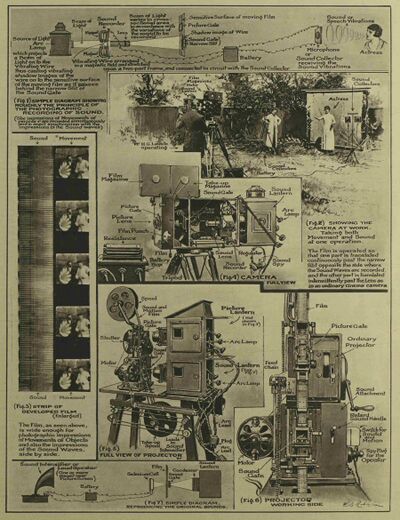 Series of diagrams illustrating Lauste’s Sound and Scene camera and projectors. Robinson, W. B. (1920). “Speaking Movies: Synchronising Sound and Picture”. Illustrated London News (January 10, 1920): p. 45.

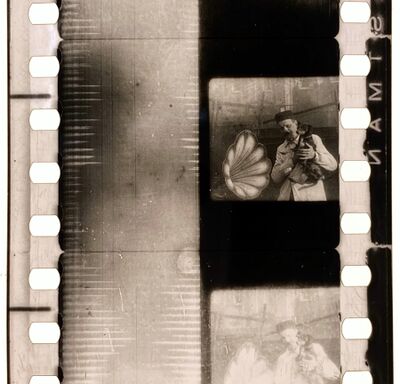 Duplicate of a Lauste Sound and Scene experiment, with the variable-density soundtrack (left) and the image (right) recorded simultaneously. Original experiments dated 1911–1912. 35mm nitrate print, c. 1935. George Eastman Museum, Rochester, NY, United States.

A more systematic laboratory-based approach emerged with the Case Research Laboratory Optical Sound (c.1922–1926). The Case laboratory developed experimental variable-density optical soundtracks using modified motion picture cameras, projection mechanisms, and a Bell & Howell Model D printer repurposed for sound exposure. Rather than encoding sound as a narrow standardized track, Case’s system produced variable-density sound recordings as complete photographic images.


Documented experiments include variable-density recordings of the spoken alphabet (A–Z), preserved in laboratory notebooks dated May 9, 1924. These recordings functioned as calibration tests and analytical tools, allowing researchers to study sound-to-image correspondence through direct visual inspection of density patterns. This approach emphasized laboratory control, apparatus modification, and photographic analysis over compatibility with existing projection standards.
Although neither Lauste nor Case systems were commercialized, their work established critical conceptual foundations for later optical sound technologies by demonstrating that sound could be recorded, analyzed, and reproduced as a photographic inscription on film.
Reference:
Case Research Laboratory Optical Sound(1922–1926): https://www.filmatlas.com/entry/355
Lauste Sound and Scene(1904–1913): https://www.filmatlas.com/entry/325
Interesting read: Writing sound with a human ear: reconstructing Bell and Blake’s 1874 ear phonautograph
https://journal.sciencemuseum.ac.uk/article/writing-sound/#introduction
Transition Toward Standardized Variable Density Systems (Late 1920s)
The experimental practices developed by laboratories such as Case informed the emergence of more standardized variable density sound systems in the late 1920s. These later systems retained the photographic encoding principles explored in earlier experiments while introducing narrower track geometries, improved amplification, and greater compatibility with industrial printing and projection workflows.
Variable density sound emerged during the transition from silent to synchronized sound cinema. Early optical sound systems favored density-based encoding because it aligned closely with existing photographic and laboratory practices. Continuous tonal variation could be recorded using familiar exposure control techniques, making VD sound attractive to studios and film laboratories adapting to synchronized sound.
Major early adopters included systems developed by Fox Movietone and RCA Photophone. These systems demonstrated that optical soundtracks could be photographically stable, mechanically reproducible, and synchronized with image projection.
Industrial Adoption
By the late 1920s, variable density sound had become a dominant studio recording format. Sound was typically recorded in controlled laboratory environments, where exposure, development, and duplication parameters could be carefully managed. VD sound integrated smoothly into studio workflows that already relied on film sensitometry, printing lights, and chemical process control.
Classic Optical Sound Recording
Studio Recording and Laboratory Practice
Variable density sound was particularly well suited to studio and laboratory use rather than direct exhibition. Recording systems relied on precision light modulation devices and stable photographic processing. Sound engineers could adjust exposure levels, contrast, and density response during recording and development, treating the soundtrack as a photographic object as much as an audio signal.
This laboratory orientation encouraged the development of intermediate formats that prioritized signal control and noise reduction over projector compatibility.
Studio Formats
Studio variable-density formats refer to intermediate optical sound configurations used during recording, mixing, and mastering. These formats were not intended for projection and often required specialized playback and combining equipment unavailable in standard cinema projectors.
Push-Pull Variable Density
In push-pull VD systems, two complementary density tracks are recorded with inverse modulation. When combined during playback, common noise components—such as film grain or exposure irregularities—are partially canceled, improving signal-to-noise ratio. Push-pull recording was used primarily in studio mastering stages rather than release prints.
Split-Track and Multi-Track Formats
Some laboratory workflows employed split or multiple variable-density tracks to allow balancing, testing, or selective recombination before final mixdown. These formats functioned as technical intermediates rather than exhibition standards.

Release formats are finalized optical soundtracks intended for mass printing and direct playback on standard film projectors and editing tables.
Variable-density (VD), Unilateral variable-area (VA), Bilateral variable-area, Duplex variable-area...

Printing, Duplication, and Noise Characteristics
Variable density soundtracks were sensitive to photographic variability. Grain structure, exposure inconsistency, development drift, and duplication generational loss directly affected noise and distortion levels. Each printing generation tended to increase background hiss and reduce dynamic range.
These characteristics made VD sound increasingly problematic as film distribution scaled up. High-volume duplication for theatrical release placed demands on consistency and robustness that density-based encoding struggled to meet.

Restoration of variable density film soundtracks: https://www.researchgate.net/figure/Cut-off-of-the-first-soundtrack-a-before-restoration-b-after-restoration-Cut-off-of_fig1_281352892
Transition to Variable Area Sound
By the early 1930s, variable area (VA) sound systems began to replace variable density sound for theatrical release printing. Variable area tracks encoded sound as geometric width variations rather than density changes, making them less sensitive to film grain and photographic inconsistencies.
The transition did not represent a failure of variable density as a recording method, but rather an industrial optimization. VD sound remained valuable in studio and laboratory contexts even as VA became the dominant release format.
Archival and Research Relevance
Variable density sound remains highly relevant in archival and research contexts. Many early sound films survive only as VD optical tracks, requiring careful calibration during digitization and restoration. Modern optical sound scanning workflows must account for photographic density response, exposure history, and noise characteristics unique to VD encoding.
Understanding variable density sound is therefore essential for film preservation, historical audio reconstruction, and media-archaeological research into early sound cinema technologies.
Reference:
Optical Sound – General Overviews
Widescreen Museum, Classic Optical Sound Recording https://www.widescreenmuseum.com/sound/RCA06-4.htm
Wikipedia contributors, Optical sound https://en.wikipedia.org/wiki/Optical_sound
Endpoint Audio, Optical Sound – Technical Detail https://www.endpointaudio.com/optical-sound-detail
Variable Density and Variable Area Sound
National Film and Sound Archive of Australia (NFSA), Variable Density https://www.nfsa.gov.au/preservation/preservation-glossary/variable-density
National Film and Sound Archive of Australia (NFSA), Variable Area https://www.nfsa.gov.au/preservation/preservation-glossary/variable-area
Sprocket School Wiki, Variable Density https://www.sprocketschool.org/wiki/Variable_density
Sprocket School Wiki, 16mm Sound Formats https://www.sprocketschool.org/wiki/16mm_sound_formats
Historical Systems and Early Optical Sound Research
FilmAtlas, Case Research Laboratory Optical Sound (1922–1926) https://www.filmatlas.com/entry/355
FilmAtlas, Lauste Sound and Scene (1904–1913) https://www.filmatlas.com/entry/325
Audio-Visual Demonstrations
Classic Optical Sound Recording (video) https://www.youtube.com/watch?v=OjKQNykc_04
Related Historical Research
Science Museum Group Journal, Writing sound with a human ear: reconstructing Bell and Blake’s 1874 ear phonautograph https://journal.sciencemuseum.ac.uk/article/writing-sound/