Variable density sound: historical research: Difference between revisions
| Line 154: | Line 154: | ||
By the mid-1940s, variable area systems (notably RCA Photophone) became dominant due to easier duplication and quality control in large-scale printing and better consistency between lab and projection. | By the mid-1940s, variable area systems (notably RCA Photophone) became dominant due to easier duplication and quality control in large-scale printing and better consistency between lab and projection. | ||
Variable area soundtracks also became the basis for later stereo optical tracks (e.g., Dolby Stereo). | Variable area soundtracks also became the basis for later stereo optical tracks (e.g., Dolby Stereo). | ||
VD tracks remain playable on modern projectors but are rarely used in new production. | VD tracks remain playable on modern projectors but are rarely used in new production. | ||
==Optical Sound on Film to the Present Day== | ==Optical Sound on Film to the Present Day== | ||
Optical sound remained in use for decades—even after the introduction of magnetic and, later, digital sound formats—due to the widespread infrastructure built around projectors and film prints. From the 1970s onward, optical stereo formats and digital sound (e.g., Dolby Digital) supplemented or replaced analogue tracks, but optical analogue remains part of the film print standard for compatibility. | Optical sound remained in use for decades—even after the introduction of magnetic and, later, digital sound formats—due to the widespread infrastructure built around projectors and film prints. From the 1970s onward, optical stereo formats and digital sound (e.g., Dolby Digital) supplemented or replaced analogue tracks, but optical analogue remains part of the film print standard for compatibility. | ||
Revision as of 20:50, 26 December 2025
Variable Density Soundtrack on Film
Variable Density (VD) is an optical analogue soundtrack format in which audio information is recorded on film as a continuous variation in photographic density along the optical soundtrack area. The soundtrack modulates the opacity of a narrow strip next to the picture frames; when light passes through it during projection, changes in density result in corresponding electrical signals that are converted back into sound.
Overview
Optical soundtracks encode audio signals as optical variations directly on the film strip. Two primary analogue optical formats were used historically:
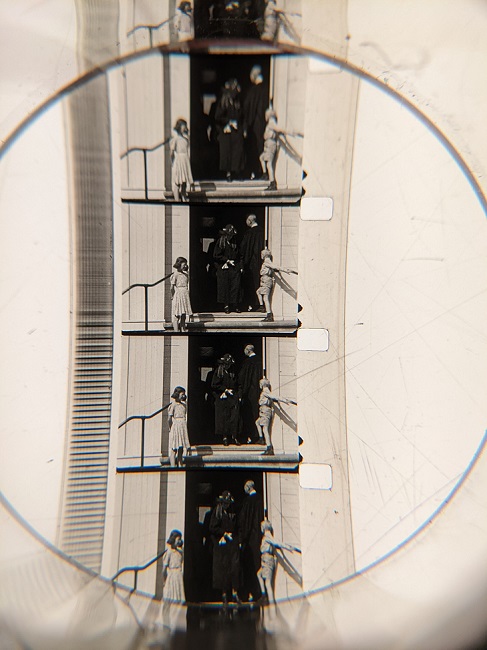 Variable Density (VD): the darkness of the soundtrack varies with the sound waveform.

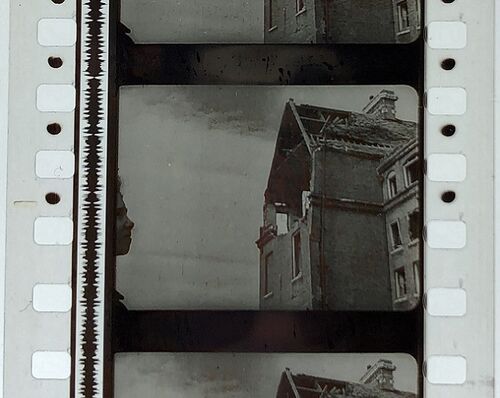 Variable Area (VA): the width of a clear area (against opaque background) varies with the sound waveform.

VD and VA compete in mechanisms of encoding but use the same playback hardware. Variable density predominated in the early sound era and was gradually replaced by variable area due to ease of printing and noise performance.
image source:
https://www.archives.gov/preservation/formats/motion-picture-film-identify-formats.html
Definition and Technical Description
Variable Density
A variable density soundtrack represents audio by varying the opacity (density) of the soundtrack area on the film. As the film passes a light in the projector’s sound head, the varying density modulates light reaching a photoelectric cell, producing an electrical signal that mirrors the original audio waveform.
In VD, every part of the soundtrack has the same width; it’s the degree of transparency that changes.
This produces a continuous optical waveform corresponding to amplitude.
VD tracks can be read by the same optical readers as VA tracks.
Variable Area
Variable area soundtracks record sound by altering the width of a transparent region against an opaque background, with amplitude reflected in the extent of the clear area rather than its density.
VA became the standard from the mid-1940s onward due to lower signal variability during printing and better noise performance in mass production.
Video Clip 4: Classic Optical Sound Recording
https://www.nfsa.gov.au/preservation/preservation-glossary/variable-density
https://www.sprocketschool.org/wiki/Variable_density
https://www.sprocketschool.org/wiki/Variable_area
https://en.wikipedia.org/wiki/Optical_sound
Principles of Operation
Both VD and VA tracks work on the same basic optical principle:
A light source illuminates the soundtrack area.
Sound-modulated variations on the film affect how much light passes through.
A photoelectric cell (phototube or photodiode) converts fluctuations in transmitted light into electrical signals.
These electrical signals are amplified and output as sound.
Early VD systems sometimes used specialized variable-intensity lights (e.g., Aeo-lights) or light valves to achieve the density modulation.
Endpoint Audio Labs:https://www.endpointaudio.com/optical-sound-detail
Widescreen Museum: https://www.widescreenmuseum.com/sound/RCA06-4.htm
History
Pre-Cinema Optical Sound Development (Early 1900s)
Before commercial optical sound systems, inventors like Eugène Augustin Lauste experimented with optical transcription of audio. Lauste developed sound-on-film prototypes that used both variable area and variable density techniques in the 1900s–1910s.
Lauste Sound and Scene(1904–1913) (Photocinematophone, Laustophone) A series of interrelated experiments using both variable-density and variable-area to create some of the first sound-on-film with synchronized picture recordings.
Film Atlas: https://www.filmatlas.com/entry/325

Series of diagrams illustrating Lauste’s Sound and Scene camera and projectors.
Robinson, W. B. (1920). “Speaking Movies: Synchronising Sound and Picture”. Illustrated London News (January 10, 1920): p. 45.

Duplicate of a Lauste Sound and Scene experiment, with the variable-density soundtrack (left) and the image (right) recorded simultaneously. Original experiments dated 1911–1912. 35mm nitrate print, c. 1935.
George Eastman Museum, Rochester, NY, United States.
Writing sound with a human ear: reconstructing Bell and Blake’s 1874 ear phonautograph
https://journal.sciencemuseum.ac.uk/article/writing-sound/#abstract
Key Systems and Implementations
Phonofilm (1920s)
Phonofilm was an early optical sound-on-film system developed by Lee de Forest and improved with technical contributions from the Case Research Laboratory. It recorded sound as parallel lines of variable shades of gray, a variable density approach.
Phonofilm was produced commercially from the early 1920s and used in short films, musicals, and vaudeville recordings.
https://en.wikipedia.org/wiki/Phonofilm
https://www.leedeforest.org/Phonofilm.html
Case Research Laboratory Optical Sound (1922–1926)
The Case Research Laboratory, led by Theodore Case and Earl Sponable, developed key photoelectric and light modulation technologies (e.g., the thalofide photocell, Aeo-light) that made optical sound on film practical. These innovations were used in Phonofilm and later adapted in Movietone systems. Wikipedia
Movietone (Late 1920s–1930s)
The Movietone sound system used a variable density soundtrack and was one of the major optical sound standards in the U.S. film industry. It synchronized sound with picture on the same strip of film and helped establish 24 frames per second as the standard sound film speed. Wikipedia
Fox Film Corporation acquired Case Lab patents and mass-produced Movietone equipment and films. Wikipedia
Movietone was widely used for newsreels and features throughout the late 1920s into the 1930s.
Case Research Laboratory Optical Sound(1922–1926) (Zoephone) A variable-density, single-system optical sound technology developed by the Case Research Laboratory in Auburn, NY, United States. In its commercial form, when paired with Western Electric microphones, amplifiers and loudspeakers, the system later became known as Movietone sound.
https://www.filmatlas.com/entry/355
Other Early Contributions
Pallophotophone and Photophone
The Photophone (Alexander Graham Bell and Sumner Tainter) and related technologies like Pallophotophone represent early experiments in modulating light with audio for transmission and recording, foreshadowing later optical sound on film. Wikipedia
Transition to Variable Area and Later Developments
By the mid-1940s, variable area systems (notably RCA Photophone) became dominant due to easier duplication and quality control in large-scale printing and better consistency between lab and projection.
Variable area soundtracks also became the basis for later stereo optical tracks (e.g., Dolby Stereo).
VD tracks remain playable on modern projectors but are rarely used in new production.
Optical Sound on Film to the Present Day
Optical sound remained in use for decades—even after the introduction of magnetic and, later, digital sound formats—due to the widespread infrastructure built around projectors and film prints. From the 1970s onward, optical stereo formats and digital sound (e.g., Dolby Digital) supplemented or replaced analogue tracks, but optical analogue remains part of the film print standard for compatibility.